


Contact
Privacy
Legal Notice - Impressum
Career
News

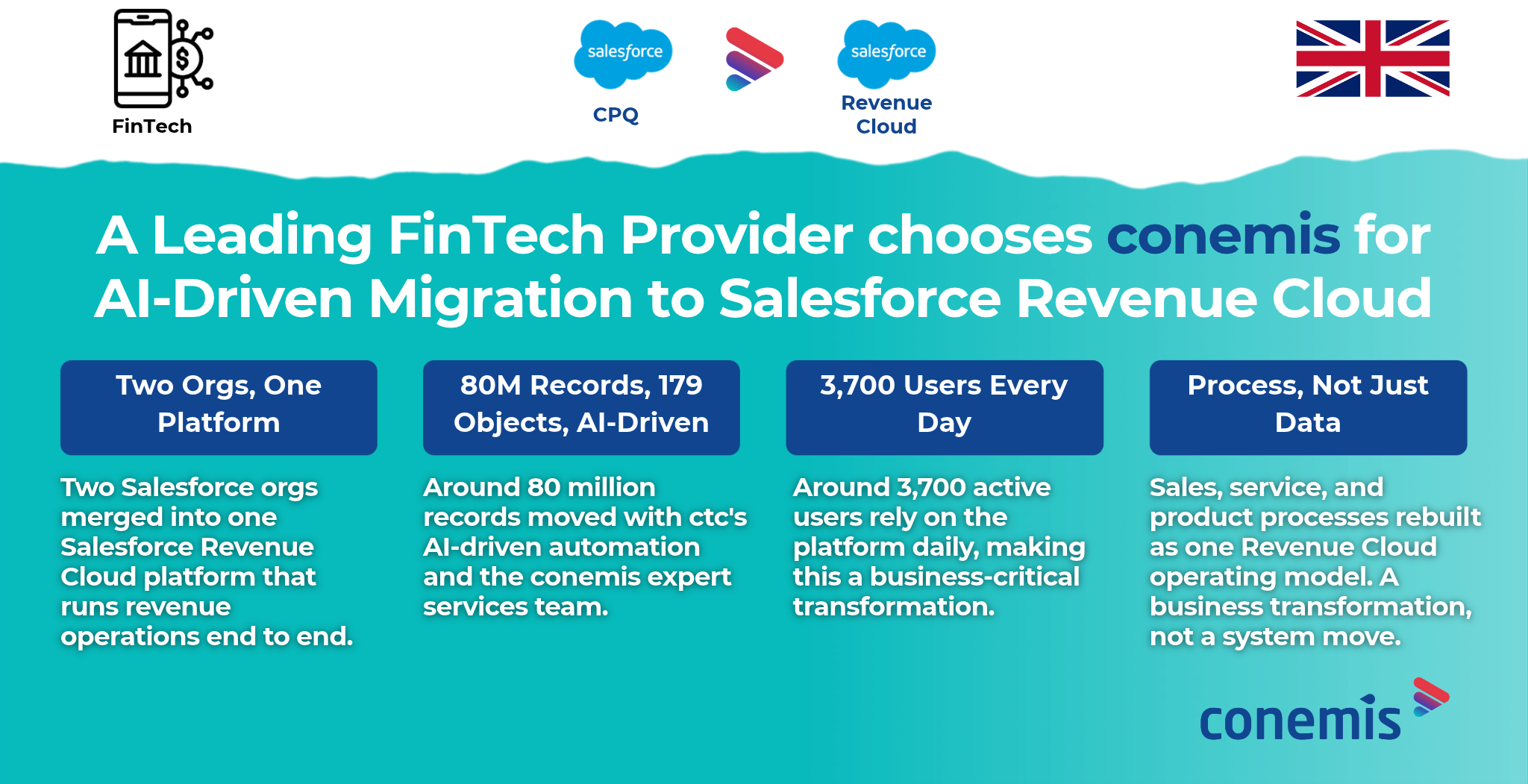
One of the hardest parts of merging two Salesforce orgs is the processes, not only the data. A global FinTech provider headquartered in the UK faced exactly that challenge and has chosen conemis to deliver its Salesforce org consolidation. The company is bringing two orgs together on Revenue Cloud to run its revenue operations end to end from one platform. To get there, they've selected conemis transition cloud (ctc) for AI-driven migration automation, backed by the conemis expert services team.
This article covers what makes these sorts of projects demanding, how it is being approached, and what other teams planning a similar move should prepare for.
The difficulty sits in the operating model, not just the record count. Around 80 million records is a large volume, but volume is not the hard part with conemis’s automated migration approach. The stakes rise with everything around it.
First, the scope is wide. The data spans 179 objects, and in a revenue platform those objects carry business rules as well as records. Every object needs a decision: keep it, merge it with its counterpart in the other org, or rebuild it in the target model.
Second, the platform is in daily use. About 3,700 active users depend on it to sell, quote, and serve customers. The business cannot pause while the migration runs, so cutover planning and repeated test loads matter as much as the final load.
Third, two orgs mean two versions of how the business works. Sales, service, and product processes grew up separately. Consolidating them is a transformation of how the company runs revenue operations, which is why the project team treats it as a business transformation rather than a system move.
A single Revenue Cloud platform gives the business one place to manage the revenue lifecycle, from product and pricing through quoting, orders, and service. For this provider, the stated goal is a single, future-ready platform that runs revenue operations end to end.
The timing also reflects a wider shift in the Salesforce ecosystem. Salesforce CPQ is end of sale, not end of life, and Salesforce positions Revenue Cloud as the path forward for quote-to-cash. Teams running CPQ today are planning when and how to make that move.
Combining the org merge and the platform move in one program has a practical advantage. The processes are redesigned once, for the target model, instead of being merged in the old platform and then rebuilt again later.
The project pairs ctc’s AI-driven automation with conemis expert services: automation handles the volume and repetition, and specialists handle the design decisions that automation cannot make.
Mapping is where the automation earns its place on a project of this width. With two source orgs and 179 objects, field-by-field manual mapping would consume a large share of the project. In ctc, AI suggests mappings between source and target metadata and highlights mismatches before cutover, so the team reviews and decides instead of building every mapping by hand.
Repeatable loads are the second lever. ctc supports delta migrations that move only what has changed, which lets the team run test cycles, correct issues, and rerun without reloading the full data set each time. With 3,700 people working in the system every day, that iteration is what keeps the final cutover predictable.
Validation is the third. Automated checks catch issues early, while they are still cheap to fix, and give the business a clear basis for signing off each load.
The process transformation itself is people work. Turning separate sales, service, and product processes into one Revenue Cloud operating model takes decisions about pricing structures, product catalogs, and ownership that only the business can make. conemis specialists work alongside the client’s team to translate those decisions into the target data model.
Teams planning a Salesforce org consolidation onto Revenue Cloud should design the target operating model before they map a single field.
Start with the processes. Agree how quoting, ordering, and service will work in the consolidated platform, then let that model drive the object and field decisions. Mapping two orgs into an undefined target produces a third version of the problem.
Count objects, not only records. Record volume drives load time, but object count drives effort. Each object needs an owner and a decision, and 179 of them make for a long decision log.
Know your data before you move it. Data profiling shows gaps, duplicates, and errors across both orgs, so cleanup happens before migration instead of after go-live. It is also the foundation for AI-ready data once the consolidated platform is live.
Plan for the users. A platform used daily by thousands of people needs a cutover plan, repeated test loads, and clear communication about what changes and when.
conemis has run consolidation projects across many CRM landscapes, including 8,000 users from five instances consolidated into one global CRM and the consolidation of Salesforce and a custom-built app into Sales and Service Cloud.
Planning a Salesforce org consolidation or a move from Salesforce CPQ to Revenue Cloud?
See how conemis handles Revenue Cloud migration, find ctc on AgentExchange, or talk to the conemis team about your project. We’d love to support your journey.