


Contact
Privacy
Legal Notice - Impressum
Career
News

Every acquisition brings a new system. Every system brings its own data model, its own object logic, and its own definition of what a client record looks like. By the time an organization decides to consolidate, the problem has usually been compounding for years, and the project scope is significantly larger than anyone originally anticipated.
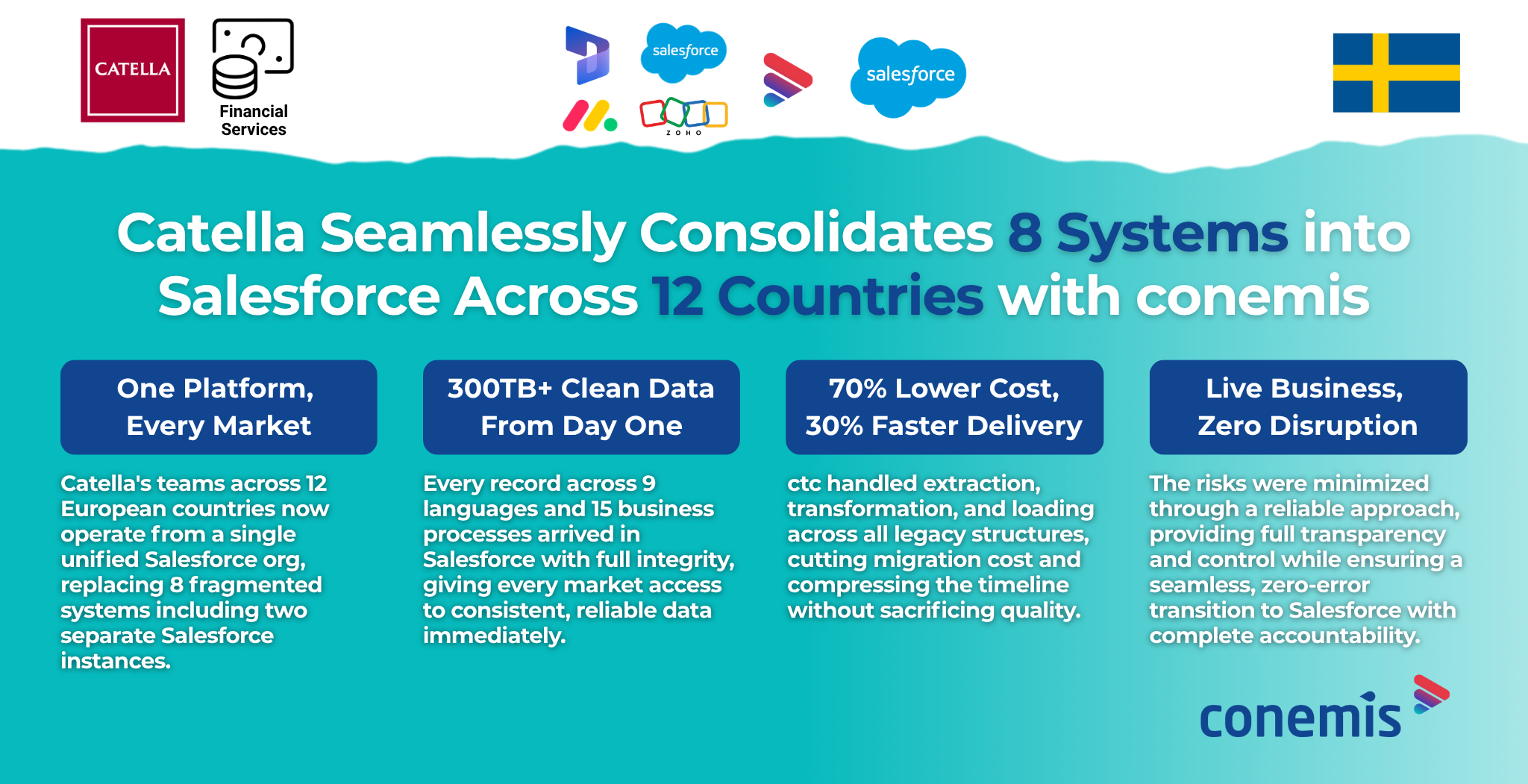
Forty years of growth left Catella with a CRM problem that no one had designed, and everyone had inherited. The pan-European investment management firm, listed on NASDAQ with 16 billion euros in assets under management across 12 countries, arrived at its Salesforce consolidation carrying 8 separate CRM systems, 300TB+ of data in 9 languages, and 15 distinct business processes that had never shared a common data model.
Catella selected conemis transition cloud (ctc) to consolidate all of it into one Salesforce platform. The consolidation delivered a 70% reduction in migration cost and completed 30% ahead of schedule with 0 errors at go-live. This article covers what the migration required, how ctc delivered it, and what the outcome tells enterprise organizations facing similar complexity about the real cost of fragmented CRM data.
The standard approach to post-acquisition CRM integration is to delay it. The acquisition closes, the target business continues operating on its existing systems, and the consolidation is scheduled for a future program. Over multiple acquisitions, it creates a landscape that is increasingly difficult to rationalize.
The operational cost is not always visible as a single line item. It shows up in client-facing teams that cannot share data across markets, in reporting that requires manual reconciliation across systems, and in technology investments that cannot be fully leveraged because the underlying data is fragmented and inconsistent.
When consolidation is finally initiated at this scale, the technical complexity is rarely scoped accurately upfront. The risks that surface most often are:
Each of the 8 source systems carried its own data model, object structure, and relationship logic. Before any production run could begin, the team needed to complete a full analysis across all sources. At Catella's scale, that meant:
The final goal is where tooling selection has the greatest leverage. Manual migration approaches, built on spreadsheet-based transformation logic and sequential system-by-system processing, cannot compress timelines at this scope.
ctc automated the end-to-end extraction, transformation, and loading process across all eight source systems, replacing manual workflows with structured, system-level mapping into Salesforce. Legacy data models were translated directly, with relationship fields resolved programmatically. Record ID rewriting, one-to-many object mappings, and complex transformation logic were executed within the platform, eliminating reliance on spreadsheets and reducing risk at scale.
Centralized control provided full visibility and governance throughout the migration. Iterative testing and validation cycles were conducted ahead of each production run to ensure data accuracy before go-live. The framework was inherently repeatable with each cycle refining the last, enabling continuous improvement without resetting the effort. This repeatability compressed the overall timeline and allowed the project to progress more efficiently despite its scale.

Singh's reference to scalability reflects a design principle that runs through ctc: the platform absorbs complexity rather than passing it to the project team as a configuration burden. Catella's first migration is already informing plans for a broader Enterprise Data program. The same framework that handled 8 CRM systems across 12 countries is extensible to any source system with a connectable API or file-based export.
The project closed with 0 errors and 100% data accountability from first run to go-live. Against the original plan:
Every Catella team now operates from one platform. The two independent Salesforce instances are now unified. Data quality is governed centrally. The institutional knowledge carried across all 8 source systems arrived in Salesforce intact, correctly structured, and immediately usable.
For any enterprise organization managing a fragmented CRM landscape inherited through M&A, those numbers establish a concrete benchmark. A consolidation of this scope, at this cost, on this timeline, with zero errors, is what the right migration platform makes possible. Read the full Catella success story.
M&A-driven CRM fragmentation is not a client-specific problem. It is a structural consequence of how European mid-market and enterprise businesses grow. Every acquisition adds a system. Every system adds a data model. Over time, the gap between what a unified platform could deliver and what the actual landscape allows becomes a measurable drag on operational efficiency, client visibility, and technology investment.
Salesforce's AI capabilities, across Agentforce and Einstein, operate on the data that lives in the org. A fragmented, inconsistent data landscape is not AI-ready. The value that AI can deliver is directly proportional to the quality and completeness of the underlying records. Organizations that defer CRM consolidation are also deferring meaningful access to AI capabilities, regardless of what platform licenses they hold.
“It was a pleasure collaborating with experts like Abhinandan Singh on this migration, professionals who truly understand the importance of automation and structured methodology in complex projects. The successful Catella migration, with high customer satisfaction, is a strong testament to this and makes me proud of our product and SME teams..”
-Omid Afaghi, Managing Director of conemis
Managing a multi-system CRM consolidation or planning a legacy migration to Salesforce? Contact the conemis team to understand what your migration actually involves before you begin.
Explore more: