Inside the ctc’s Data Transfer Module: Automated Data Migration for Enterprise Systems
February 27, 2026
by
Eren Yılmaz
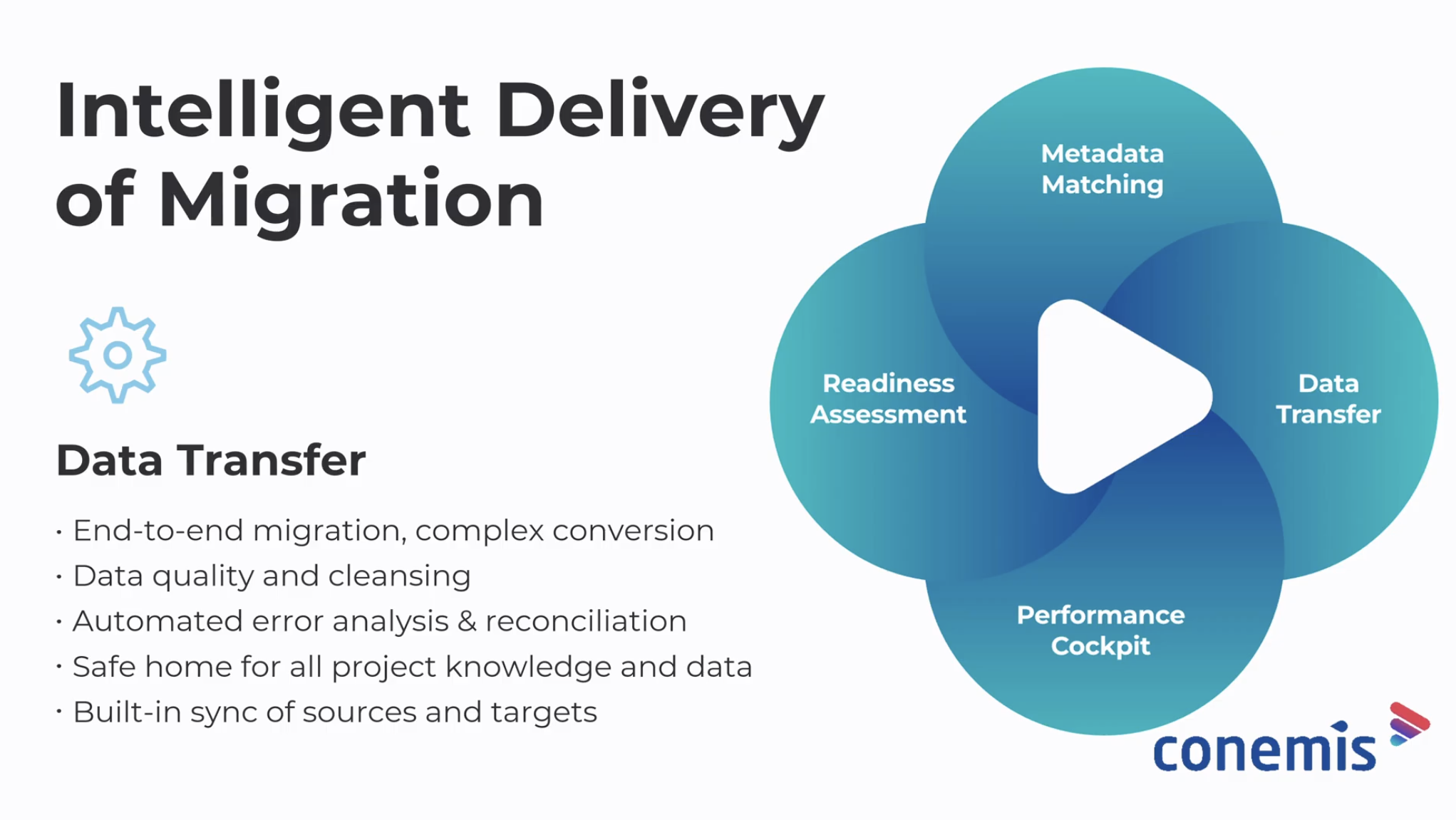
Large-scale system transformations put traditional, manual ETL processes under pressure. Spreadsheet-based mappings, file handling, and fragmented tools slow projects and increase risk. In the following demo, we walk through automated data migration in action, illustrating how extraction, transformation, loading, error handling, and scheduling work together in a single, streamlined flow.
The video demonstrates how conemis transition cloud replaces fragmented, manual activities with a centralized, transparent environment that standardizes execution, enables collaboration across project teams, and turns complex migration scenarios into a controlled, repeatable, and scalable workflow.
End-to-End Automated Migration Workflow: ctc supports automated data extraction, transformation, and loading within a centralized environment. Instead of relying on manual scripts and disconnected tools, migration activities are orchestrated in a structured workflow with built-in exception analysis and reconciliation support.
Centralized, Cloud-Based Workbench: All migration configurations, mappings, and execution steps are stored in a unified cloud workspace; providing full transparency across the project and enables teams to monitor overall migration progress with clear traceability.
Delta Migration and Iterative Loads: The platform supports delta migration capabilities, including automated delta loads, enabling iterative migration cycles and synchronization scenarios without rebuilding the migration setup from scratch.
Data Consistency and Rule-Based Processing: Built-in mechanisms such as rule-based duplicate prevention, automated data transformations (e.g., splitting and joining fields), and statistical analysis support data consistency and quality during migration.
Collaborative Multi-User Environment: Multiple users can work simultaneously within the same migration workspace. Shared configurations and centralized documentation reduce knowledge silos and support structured collaboration across project teams.
Organizations can also migrate and consolidate data across complex enterprise landscapes including Salesforce, SAP, Microsoft Dynamics, Oracle Siebel, and other industry-specific systems using ctc connectors.
Key Business Benefits of Automated Data Migration
Shorter migration cycles: Automated workflows, dependency-aware sequencing, and parallel processing reduce overall project duration and accelerate cutover readiness.
Reduced project risk: Controlled, repeatable execution and full transparency improve planning reliability and minimize delivery uncertainty.
No redundant reloads: Record-level error handling enables targeted retries instead of reprocessing complete data loads.
Consistent transformation logic: Reusable mappings deliver identical results across test runs, migration waves, and synchronization phases.
Minimal business downtime: Scheduled, high-performance loads shift processing to off-hours and protect daily operations.
Automated Data Migration vs Traditional ETL Tools
Traditional ETL tools are designed for ongoing data integration, not for time-bound transformation projects. They rely heavily on manual scripting, which slows adaptation when data models change and makes knowledge transfer difficult. Business stakeholders often lack transparency because logic is buried in code rather than centrally documented and reusable.
In addition, classic ETL approaches do not provide built-in lifecycle control for migration waves, test cycles, and reconciliation. Iterative loads, selective retries, and delta synchronization between legacy and target systems typically require custom development and additional tooling. This increases project duration, risk, and cost, especially in large enterprise programs where multiple teams must collaborate on the same migration scope.
Final Thoughts: Turning Data Migration into a Repeatable, Automated Process
Data migration becomes a controlled production workflow when automation, transparency, and reusability replace manual effort.